Philippine SeaBank's Time Deposit Auto Renew Feature
I designed SeaBank Time Deposit Auto Renew, helping users keep saving without redoing the deposit flow. This case covers how I integrated Auto Renew into an existing journey, balancing clarity, user control, and retention. Post-launch, adoption hit 22% and 72-hour drop-off fell from 44% to 27%.
Role
Product Designer
Timeline
6 months (Jun - Dec 2025)
What I Worked On
Design exploration & prototyping, cross-functional collaboration, final design delivery and UAT
Teams Involved
Product Manager, Product Designer, Engineers, Data, Local CS/Ops, Compliance Team, Business
SeaBank: helping millions build better financial habits
SeaBank is a digital bank in the Philippines, part of Monee, formerly SeaMoney, the financial services arm of Sea Group. With a mission to expand access to mobile banking across Southeast Asia, SeaBank supports everyday savers and underbanked users with simple, mobile-first financial tools.


What's the problem?
While many users redeposit their funds upon maturity, they have no efficient way to do so. This creates a post-maturity gap in which some funds go idle or leave the bank, leading to AUM leakage.
So, the challenge becomes...

How might we help users to easily set up continuous savings without disrupting their familiar flow and simultaneously minimizing AUM leakage?
and... what's the outcome
Outcome
I delivered a clear, user-controlled Auto Renew experience for SeaBank Philippines Time Deposits, so users can continue saving at maturity without redoing the deposit flow. The solution reduced post-maturity drop-off, reached the targeted adoption rate, and improved retained principal, supporting stronger long-term savings behavior and AUM retention.
Problem Validation
To validate the problem, I partnered with the Local Ops and Data teams to analyze 6 months of deposit behaviors, and we uncovered…
56%
of Time Deposit users choose to redeposit
This means there's almost half of the funds enter the leakage window.
82%
of those redeposited money have the same tenure with the previous one
Suggesting that flow repetition is redundant for loyal users.
14 days
of average "idle" duration
Users who eventually reinvest their deposit upon maturity indicate that the barrier is not "lack of money," but "lack of attention."
Business Goal
Every non-renewed deposit represents AUM (Assets Under Management) Leakage. By failing to capture intent at the moment of maturity, the bank loses liquidity to competitors.

Want a way to stop the risk of losing millions in AUM.
Every non-renewed deposit represents AUM (Assets Under Management) Leakage. By failing to capture intent at the moment of maturity, the bank loses liquidity to competitors.
Choosing the right feature
After we had a full understanding of users' problems and business goal, the first step we took to find a solution was to explore some feasible features.
1st Feature Exploration:
Notification + Shortcut
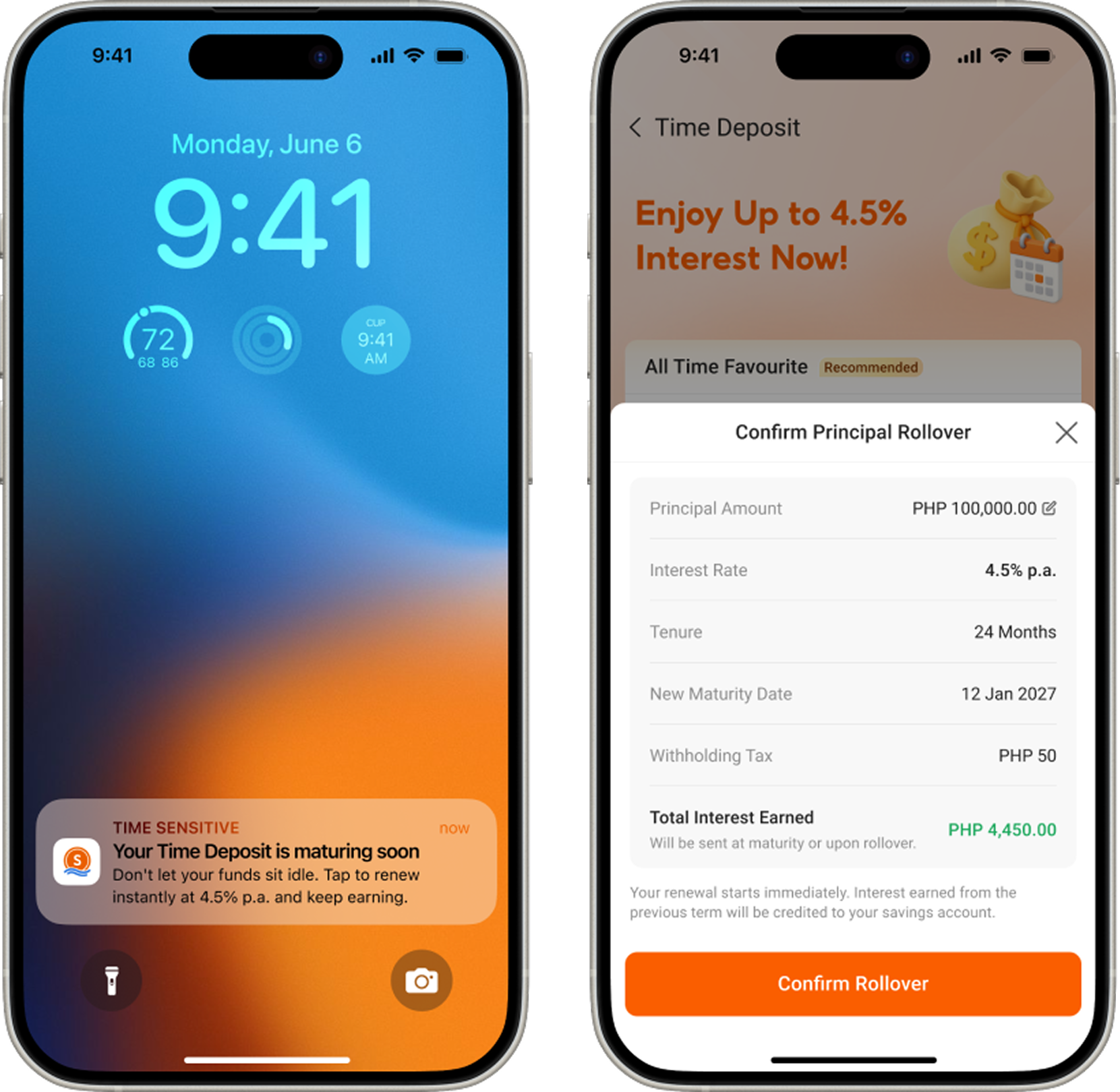
A notification will be sent 3 days before the maturity day and on the maturity day. The flow will be User taps Notification → Deep-links to a "Rollover?" Bottomsheet → User confirms (skipping the placement form).
2nd Feature Exploration:
Adding Auto Rollover Setting in the Deposit Placement Flow
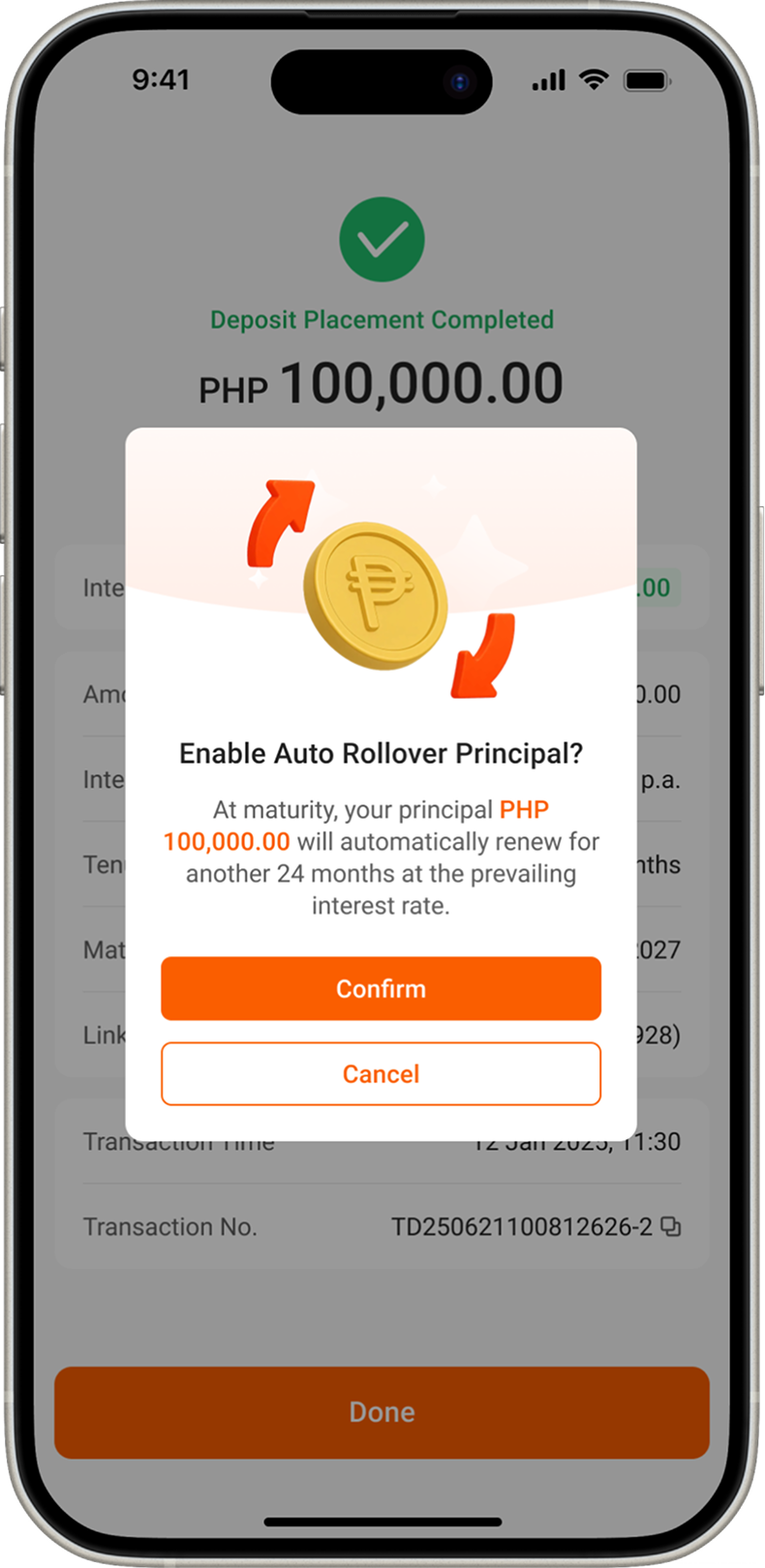
Add a new section in the placement flow to capture the renewal preference during the initial deposit placement.
and... the decision was...
✅ We chose Rollover Setting in the Deposit Flow
The reason is because it captures the decision proactively when users are already motivated, delivers high reliability once set, and requires no ongoing user attention, which eliminates the post-maturity gap and AUM leakage risk. The added step introduces only moderate friction, and we mitigated it with clear, reassuring UX.
Competitor Analysis
To deepen our understanding of the Auto Rollover feature, I partnered with local market research teams to evaluate Time Deposit auto-rollover features across top 6 banks in the Philippines.

"Zero-Guidance" Friction
Competitors present neutral options that force users to calculate trade-offs on their own, triggering Decision Paralysis and leading them to pick the manual default to stay safe.
Difficult mid-term changes
The majority of the apps hide their rollover instructions behind account details and are limited by cutoff windows near maturity.
Hidden maturity status
Rollover and maturity details are buried in account pages, with no clear countdown or visibility.

Design Principles
To guide our design decisions while keeping all stakeholders aligned, we defined our design principles. This ensures the auto-rollover feature feels intentional and natural.

User Control
Users must be able to review, adjust, or opt out with confidence.

Clear & Transparent
We prioritize Meaningful Friction, ensuring every rollover is an intentional, high-confidence choice.

Prevent Drop-offs
Design should remove friction that causes users to quit mid-flow.

Familiar by Default
Auto-rollover should feel natural, not like a new behavior.
Success Metrics
25%
Auto-Rollover Adoption
Measures user trust and willingness to proactively keep funds invested.
<30%
Post-Maturity Drop-Off (72H)
Indicates reduced idle balances and short-term AUM leakage immediately after maturity.
+8-12%
Portfolio Retention Volume
Shows sustained capital retention over time, beyond short-term feature usage.
Design Exploration: Part 1
Setting The Right Flow
When I started the design explorations, I had this one critical question: When is the right moment to ask users to decide on rollover options?
We started with...
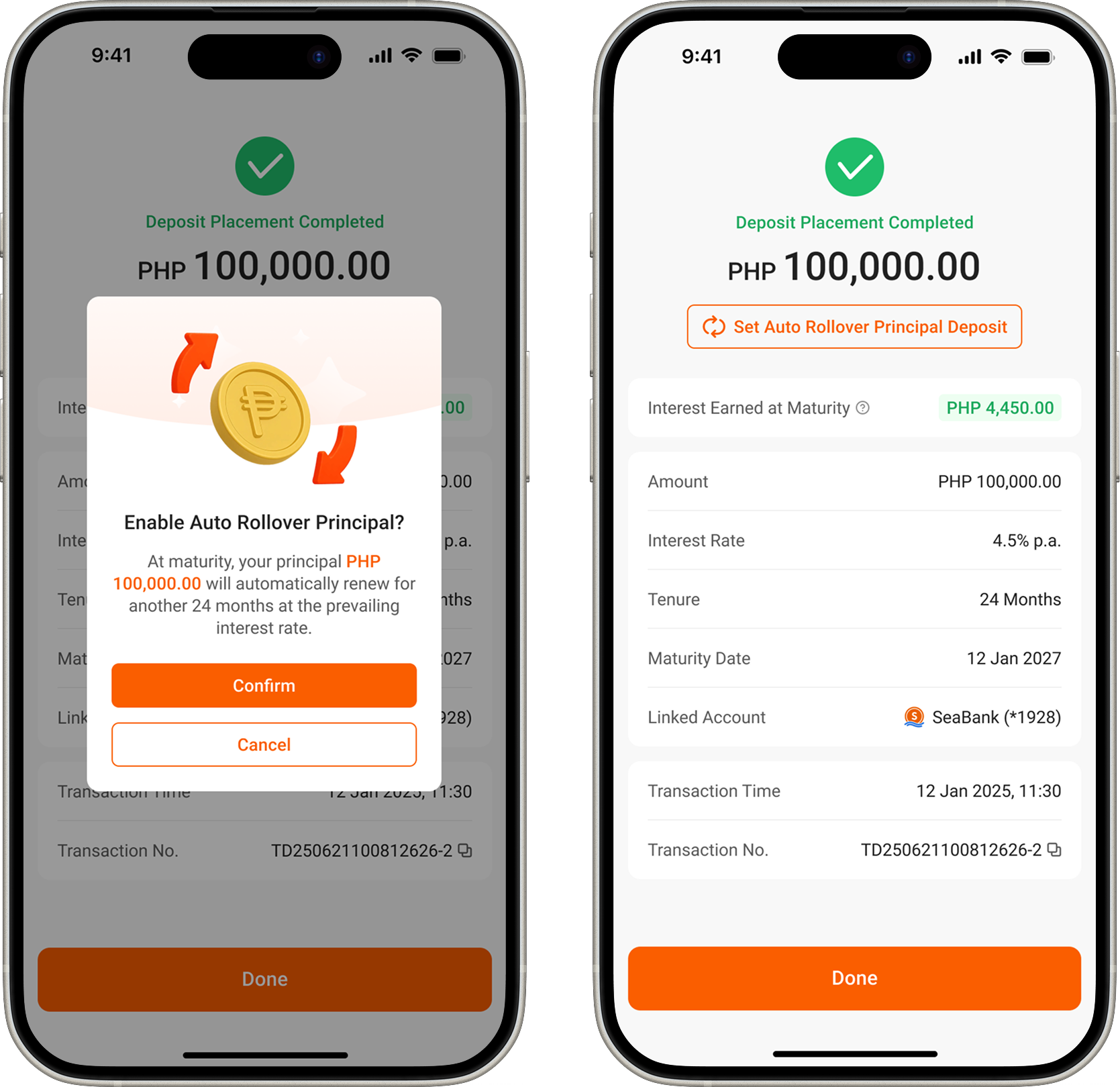
Auto Rollover After Deposit Placement
We approach this idea because it wouldn't interrupt the existing flow. But, it hid the feature at the very end, felt like an extra step, and may cause low opt-in.
So we tried...
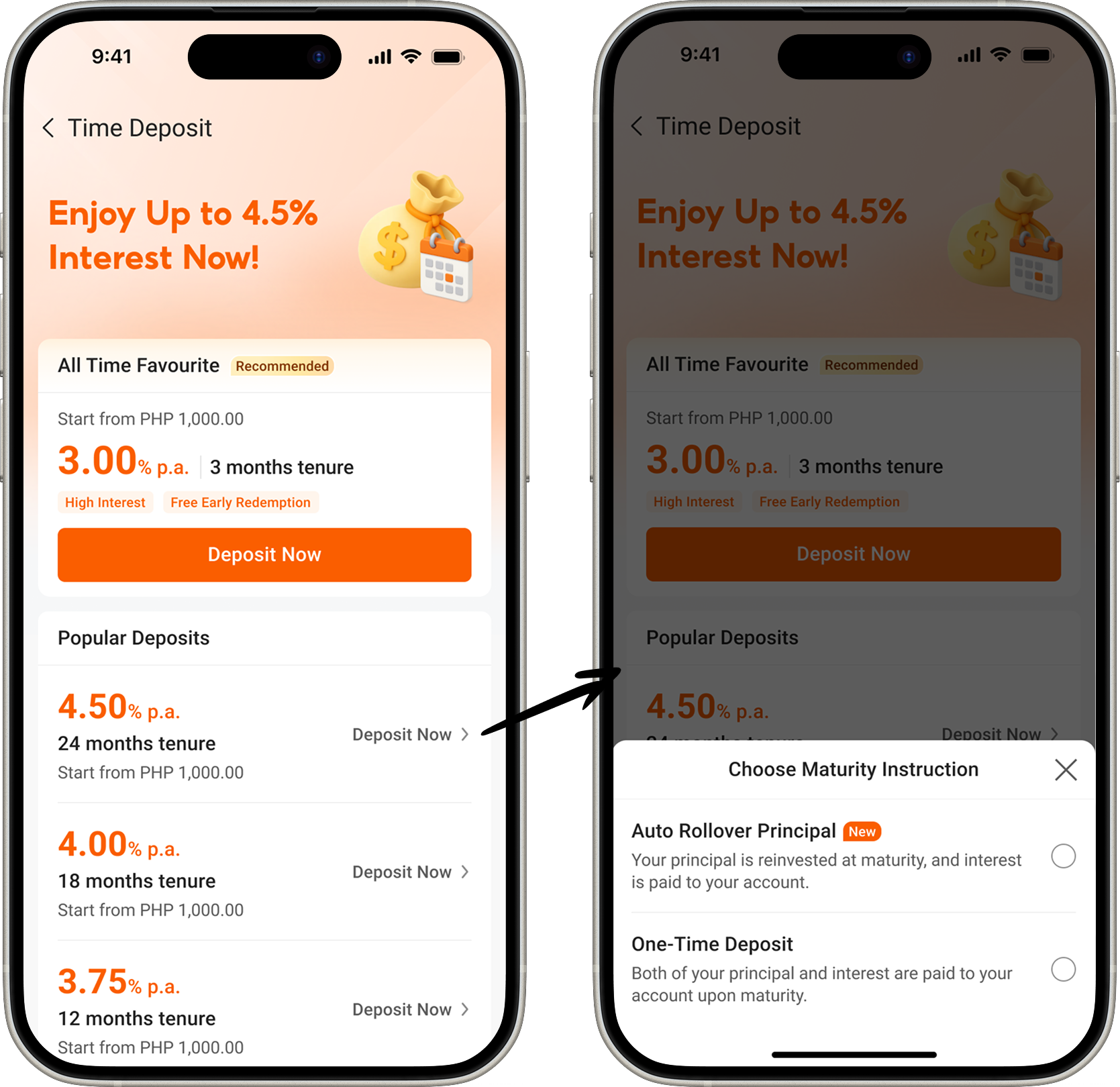
Asking Before Deposit Placement
We approach this idea to maximize visibility and lock in intent early. But it forced a decision too soon, raised cognitive load, and risked drop-off.
Finally, we went with...
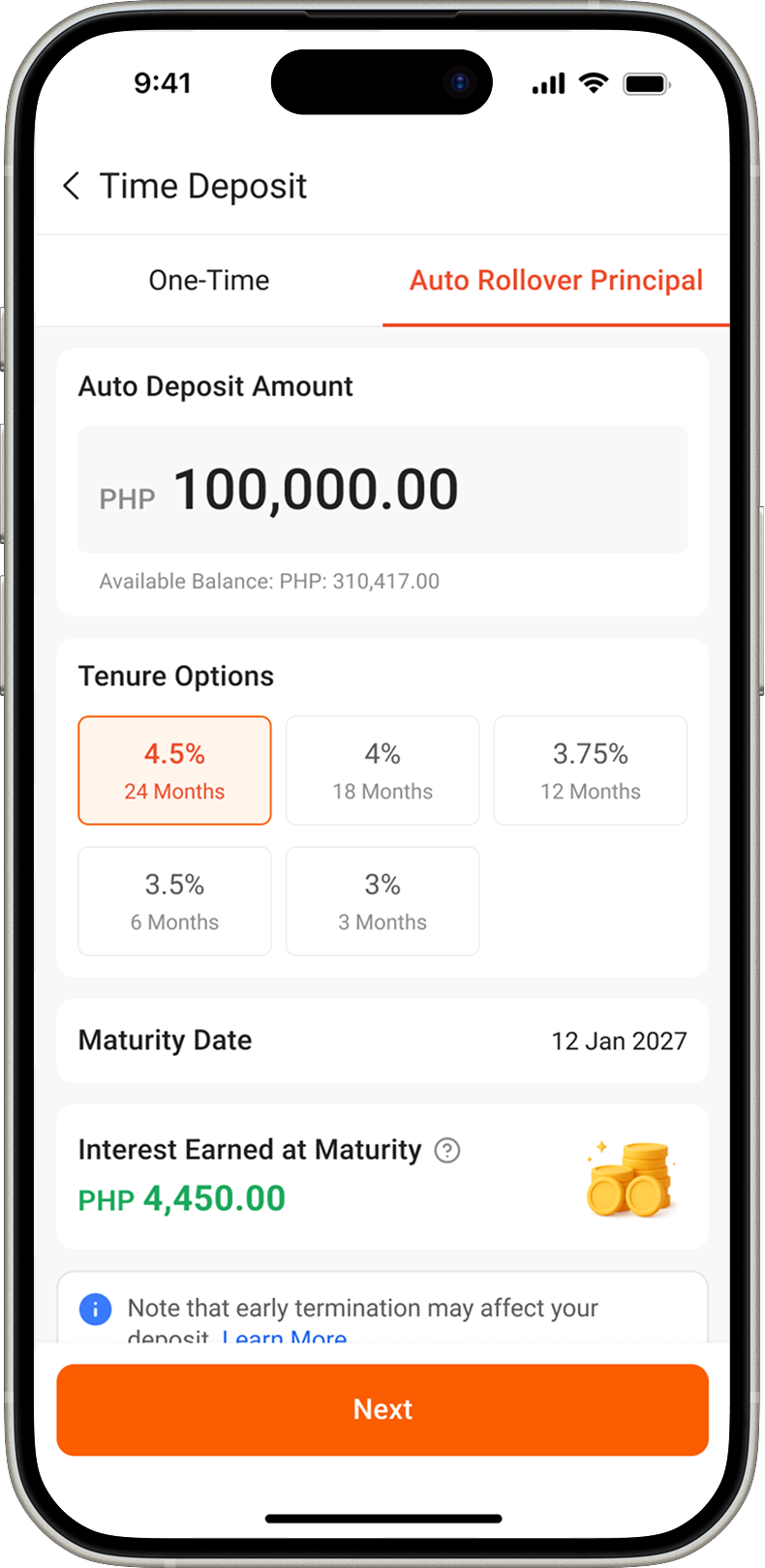
Asking Inside The Placement Page
It's the best balance because users decide with full context, with minimal disruption. Although it adds one more choice, clear copy and confirmation kept it safe and easy.
Design Exploration: Part 2
Choosing The Best Way to Display Rollover Options
After all stakeholders were aligned on the direction of the flow, I had another question: What is the best way to display it on the placement page?
Option 1:
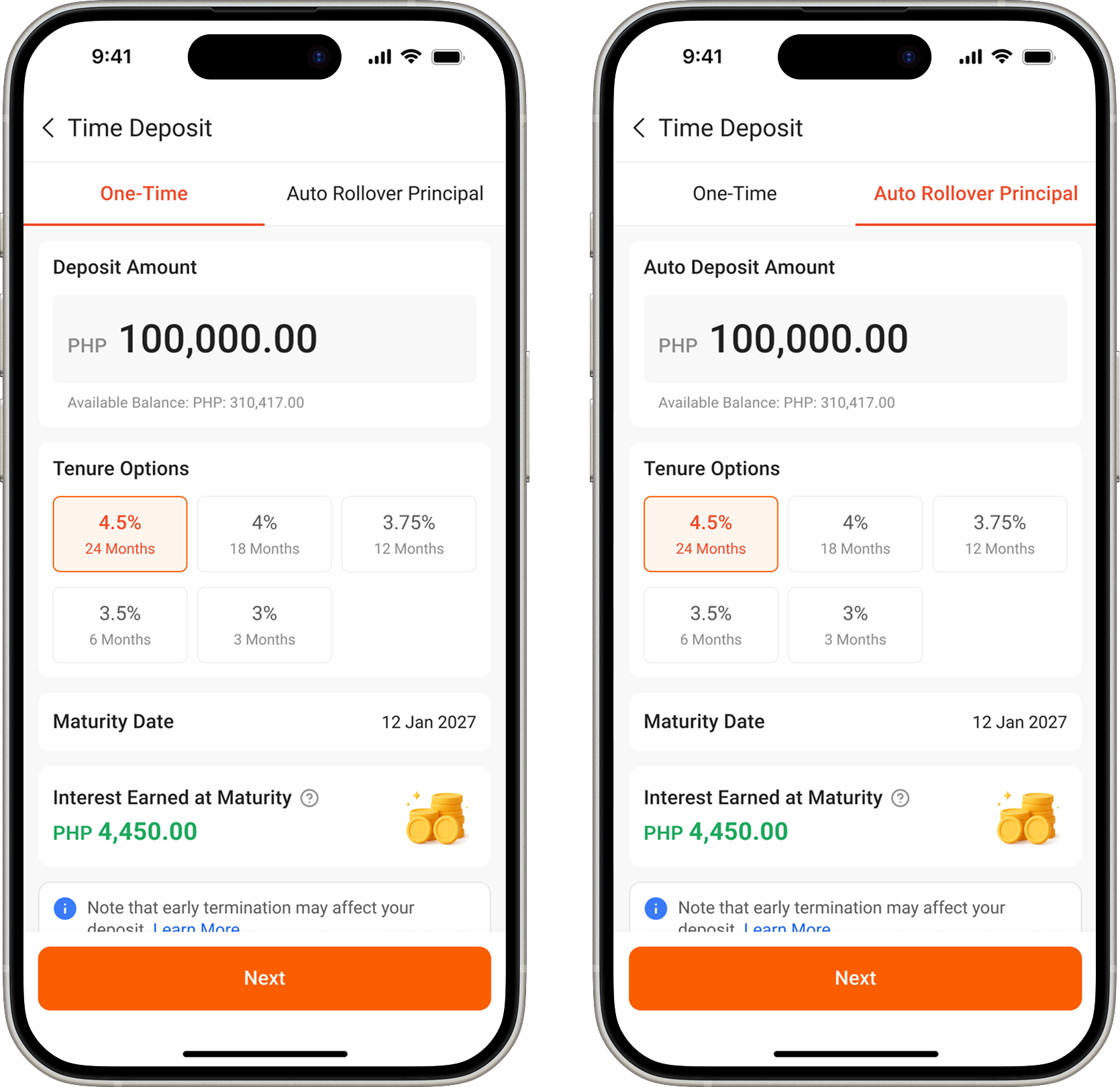
Tab
We explored tabs to maximize visibility and make switching effortless. Placing it below the top bar keeps the choice front and center, so users can compare options at a glance.
Option 2:
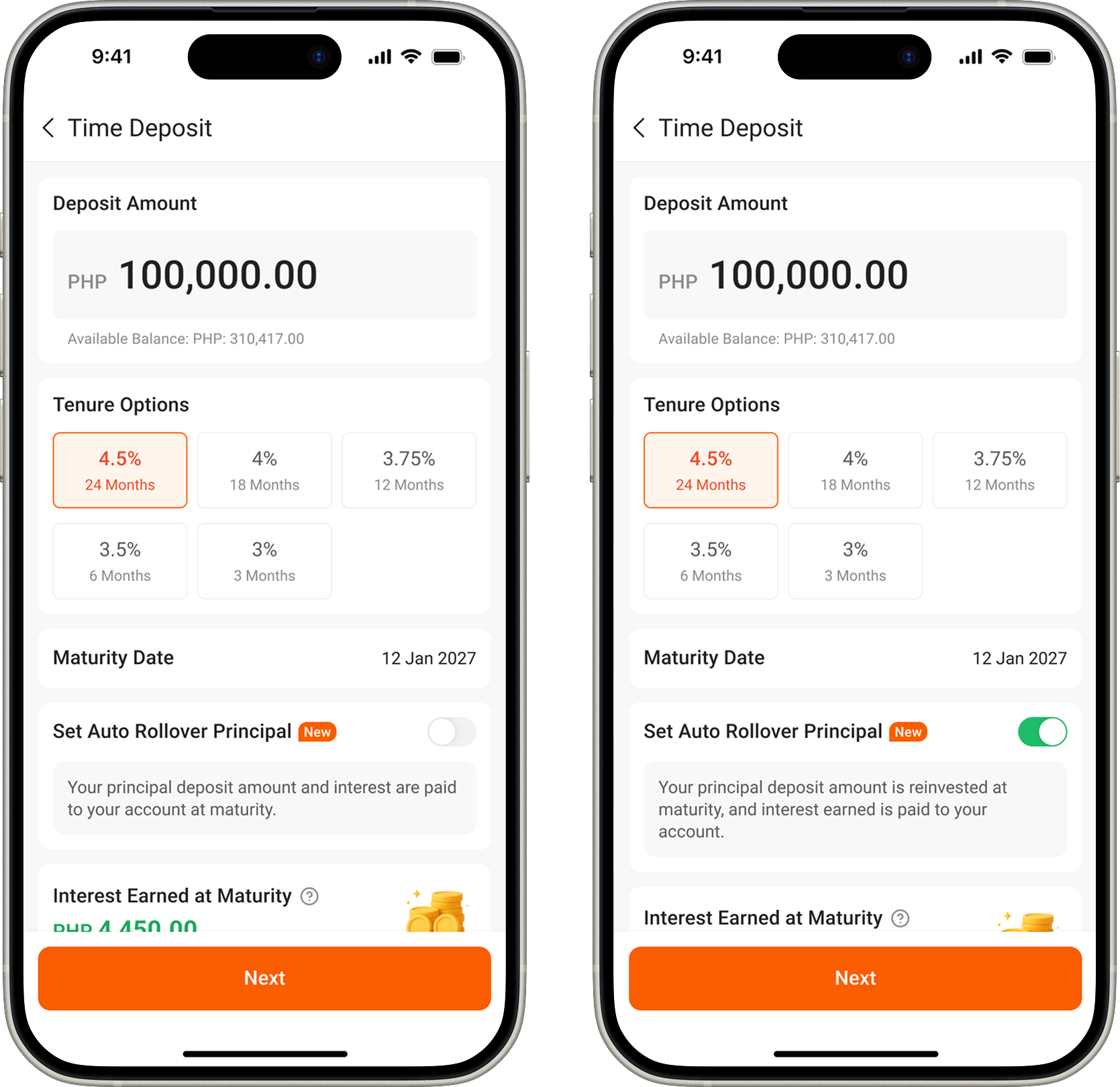
Switch Toggle
We explored a toggle to keep friction near-zero. It's familiar, thumb-friendly, and visually minimal, which helps protect placement conversion.
Option 3:
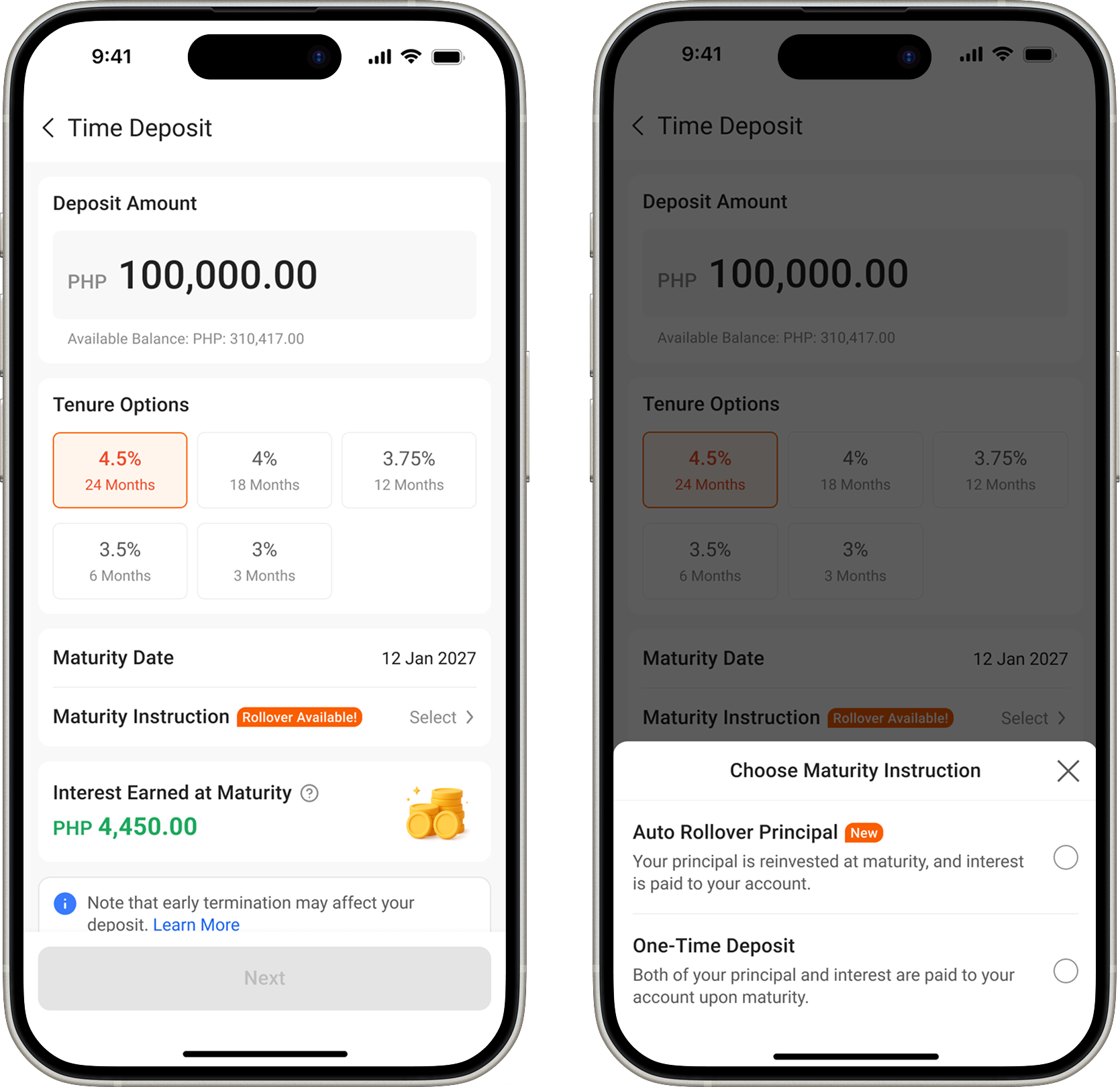
List + Bottom Sheet
We explored a bottom sheet to keep the page clean while giving enough space to explain each option clearly. It also creates a more intentional selection moment and scales well if we add more rollover options later.
and... the decision was...
✅ We chose List + Bottom Sheet
This is because it gave the best balance of clarity and consent. It clearly frames rollover as a maturity "instruction," keeps the placement page clean, and adds only moderate friction (2 taps). Most importantly, the bottom sheet creates a pause-and-review moment, which improves decision quality and reduces accidental opt-ins.
Usability Testing
To validate clarity and consent quality for the maturity instruction setup, we partnered with the PH local UX team to run moderated sessions in Manila, Philippines.

Sample Size
10-15 users per key segment (aged 25-45 y.o.):
- First-time depositors (lower financial literacy)
- Repeat investors (rate-sensitive)
Localization & Language
- Prototypes fully localized into natural-sounding Tagalog (not just direct translation)
- Sessions moderated by native speakers to capture nuanced qualitative feedback
Task
Participants completed an end-to-end deposit setup, explained what would happen at maturity in their own words, and attempted to update their maturity instruction without help.
Iteration 1:
Simplified Banking Terminologies
Problem
Solution
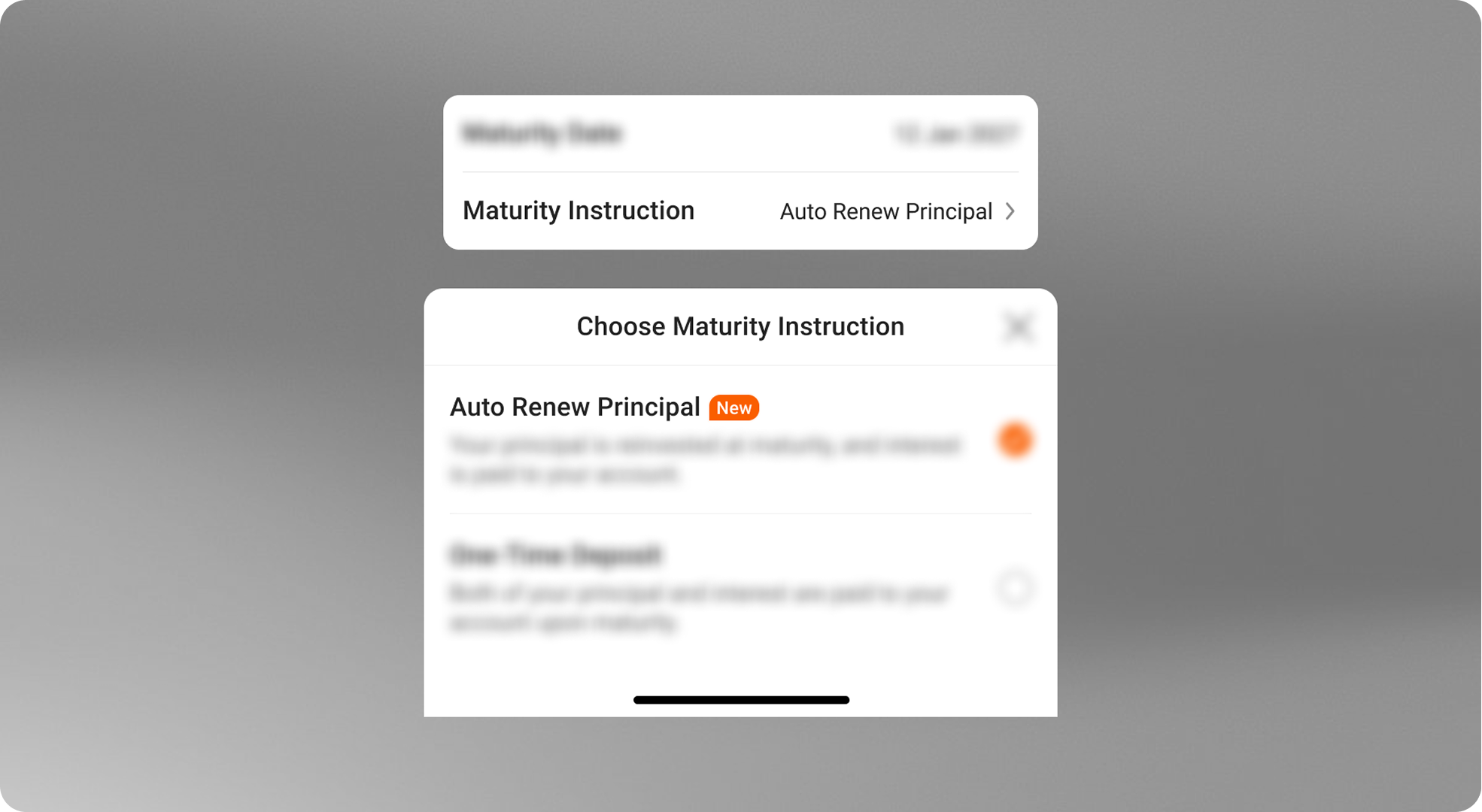
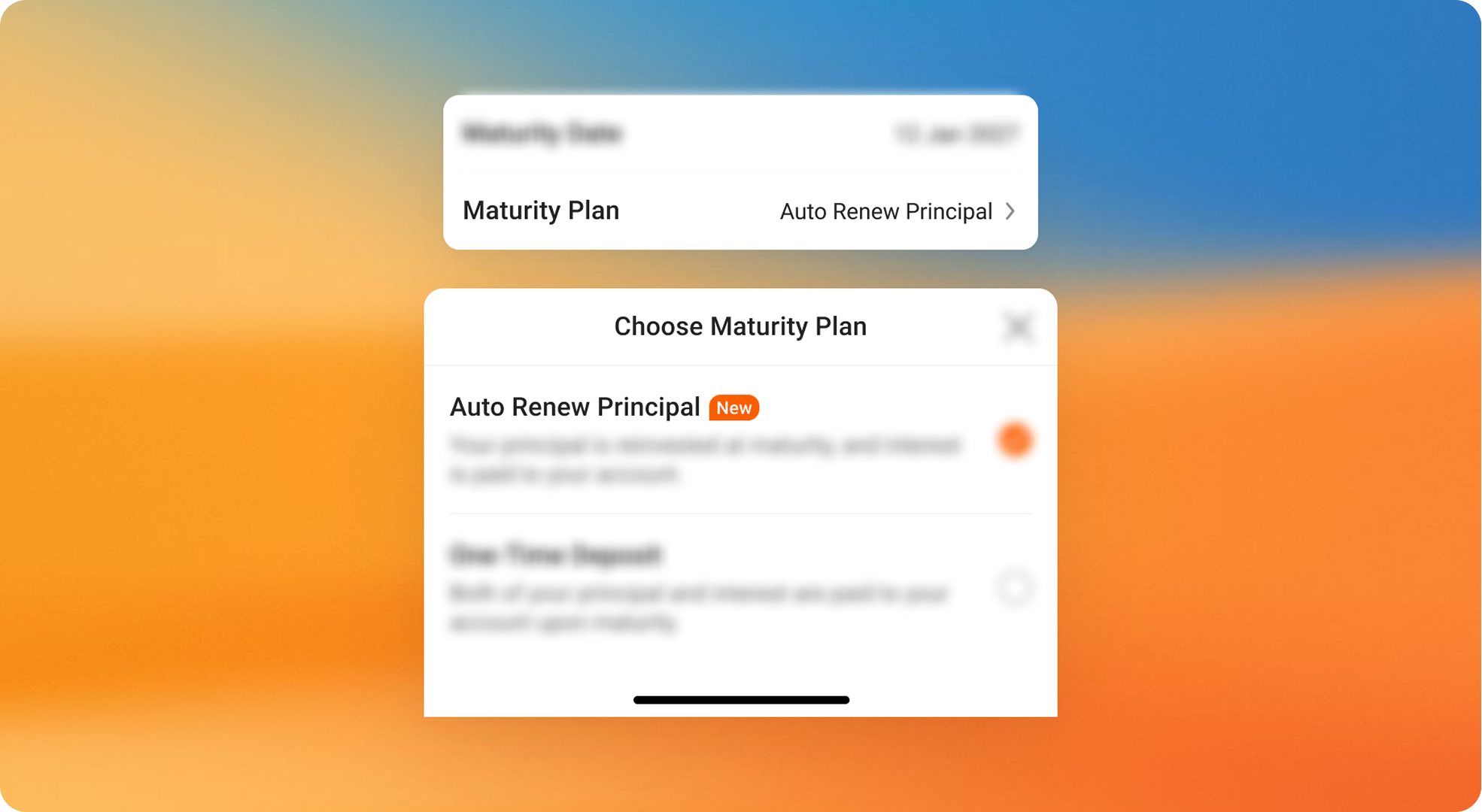
Users didn't understand "Maturity Instructions" and "Rollover," and some thought they were complicated steps.
Renamed it to Maturity Plan and Auto Renew so the meaning is immediate and action-oriented.
Iteration 2:
Prevented Accidental Inputs
Problem
Solution
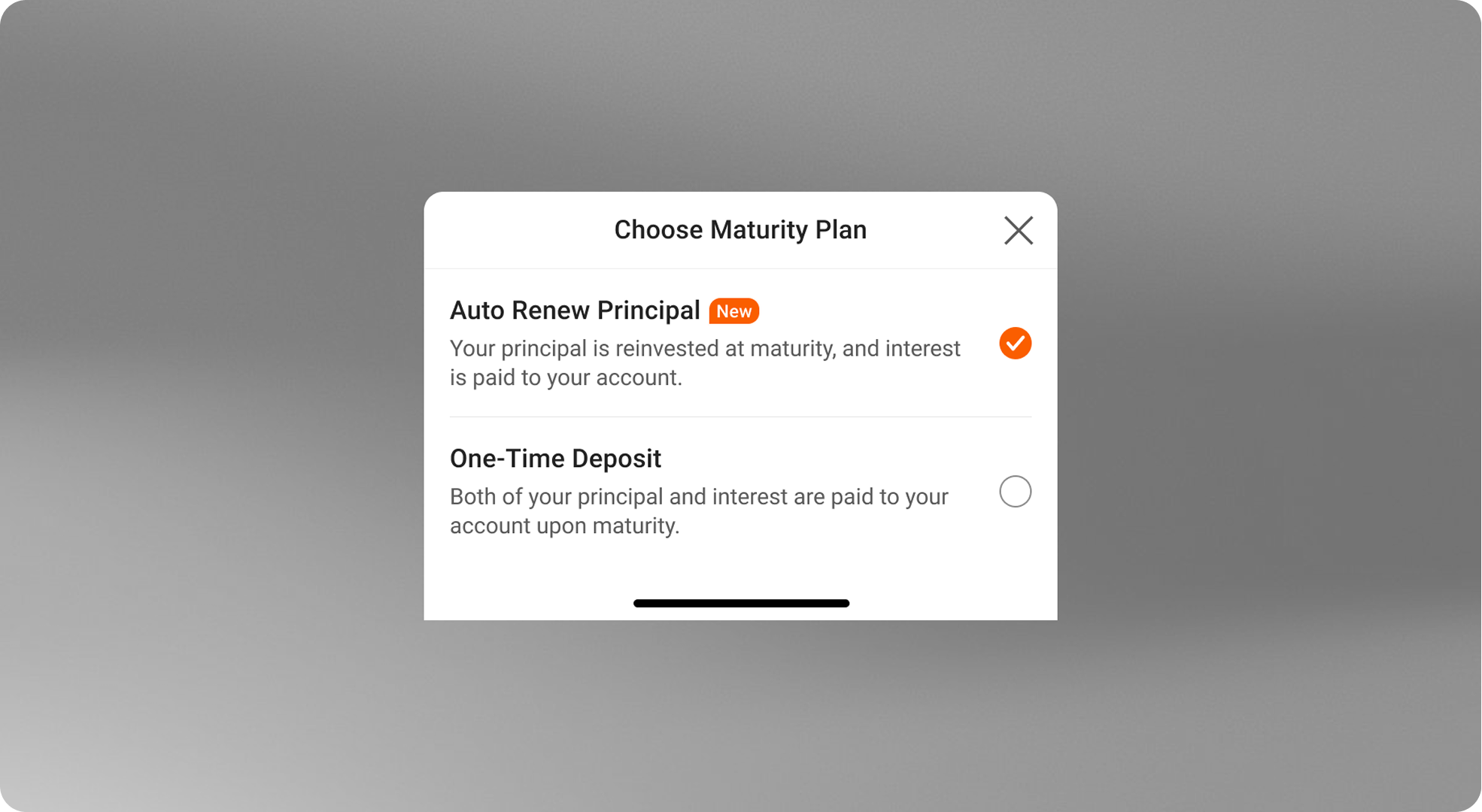
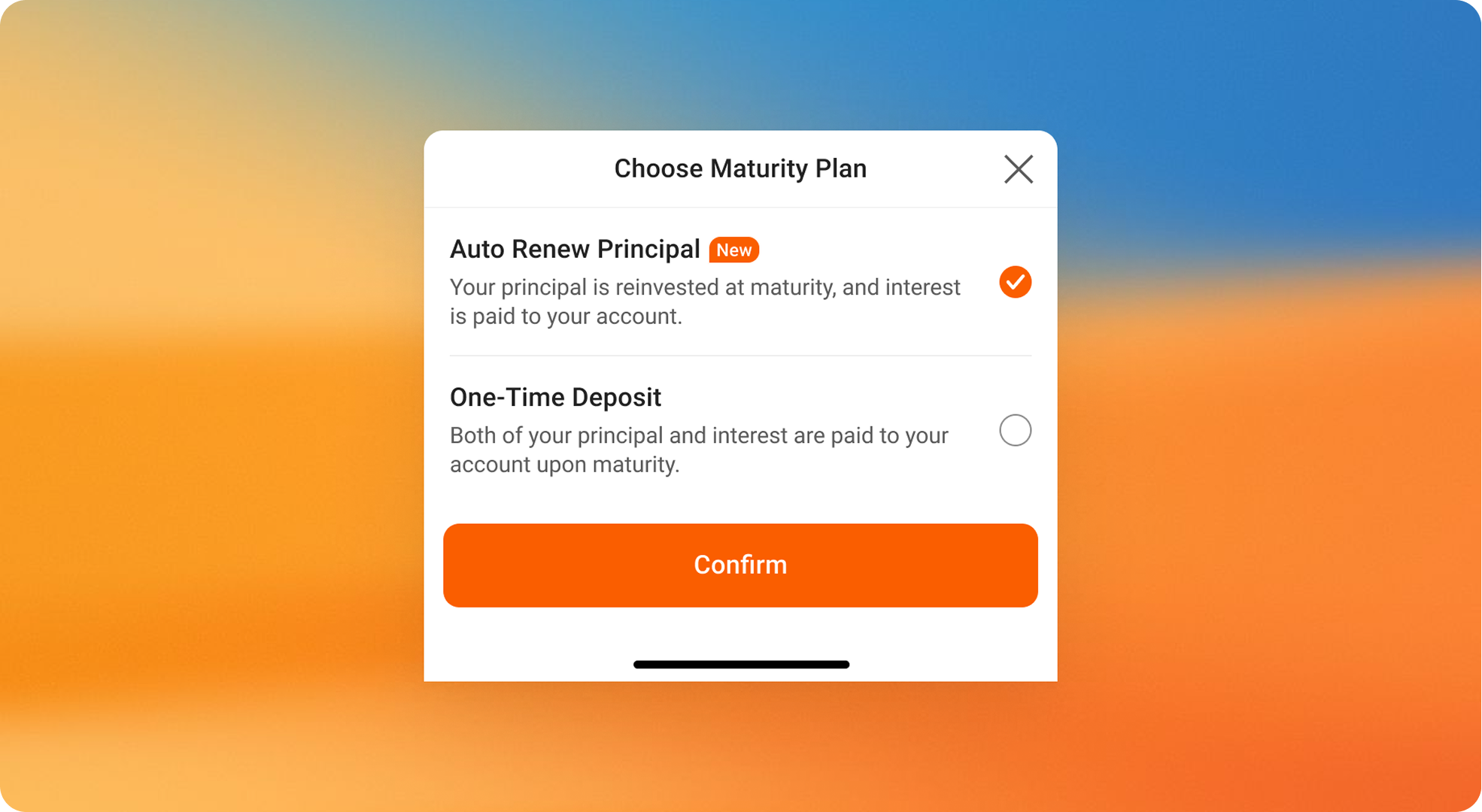
Users accidentally triggered the selector while scrolling, then lost the sheet before they finished reading.
Added a two-step commit with a sticky "Confirm" button so the sheet stays open until they finalize.
Iteration 3:
Clarifying The Changeability
Problem
Solution
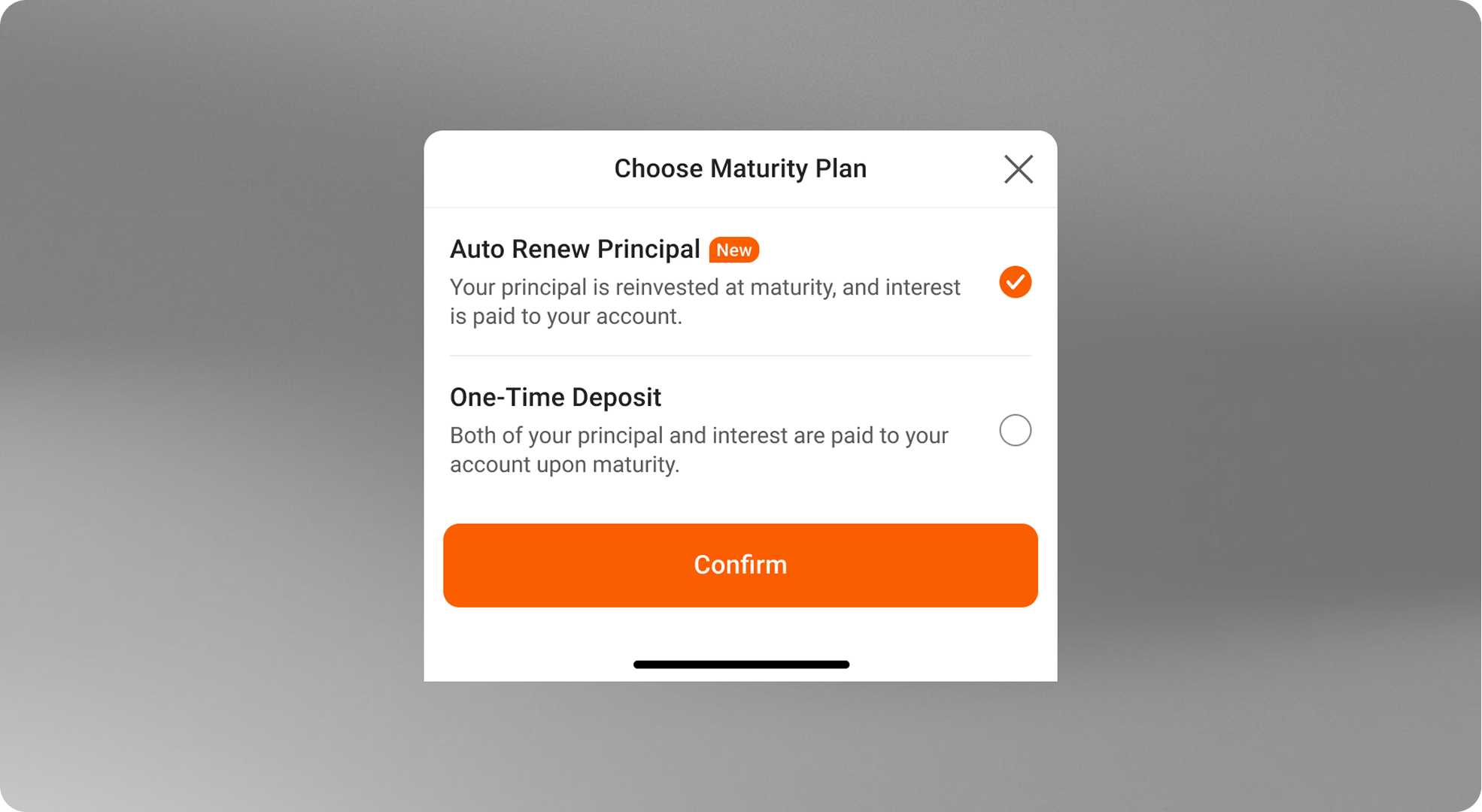
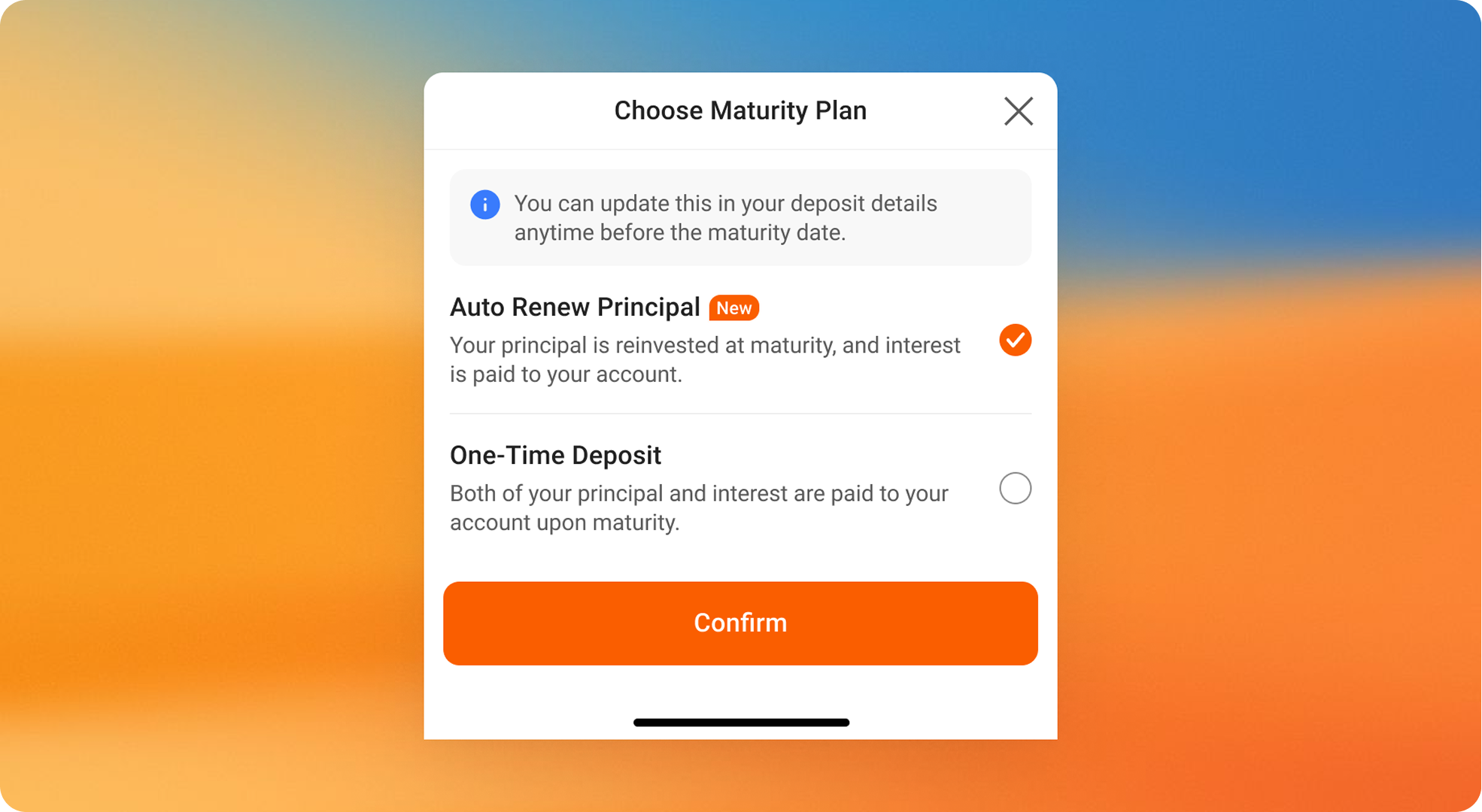
Users hesitated to confirm because they feared they'd be locked in and couldn't access money later.
Made the escape hatch explicit up front by stating they can change the setting anytime before maturity.
Final Design
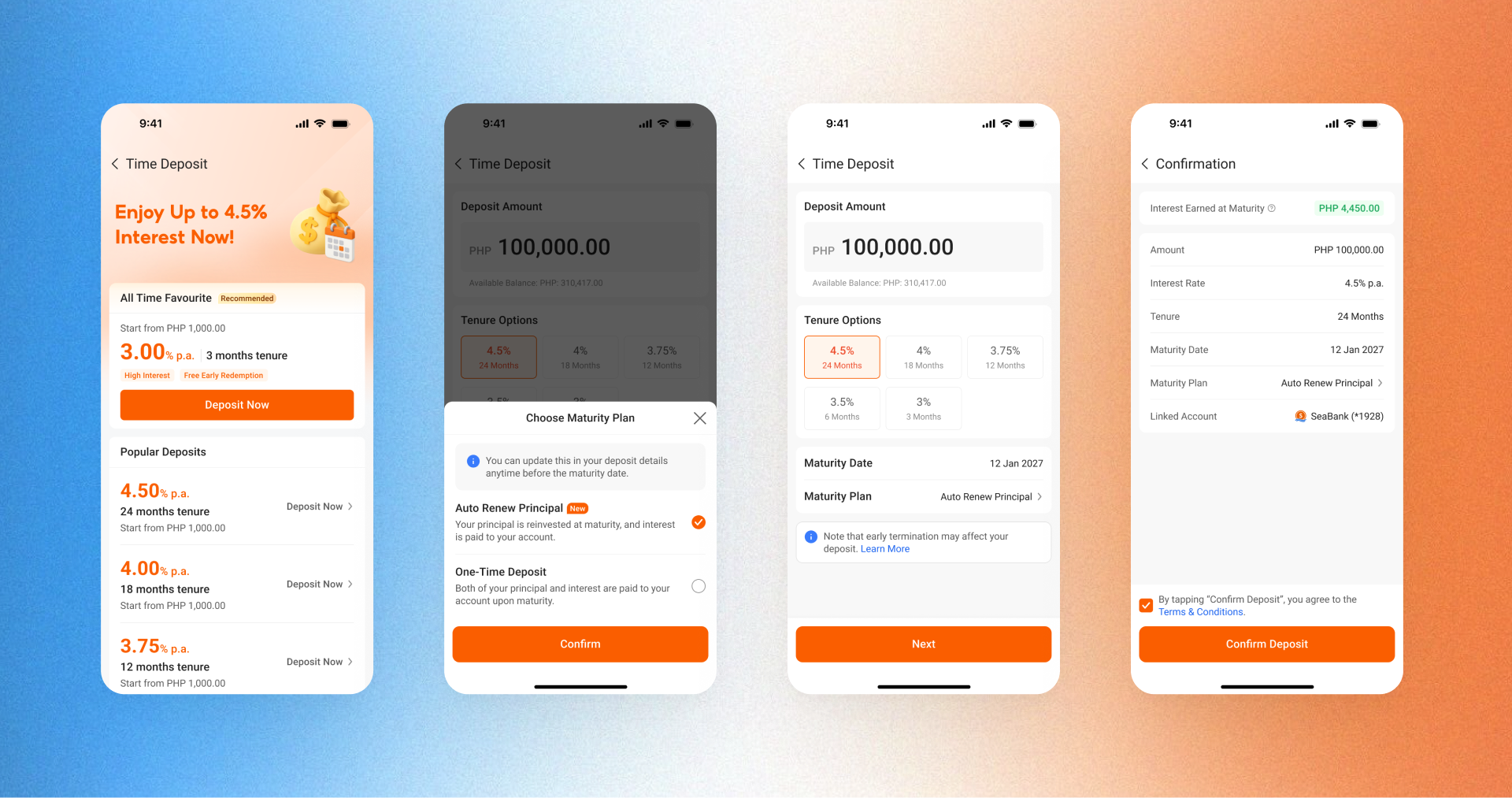
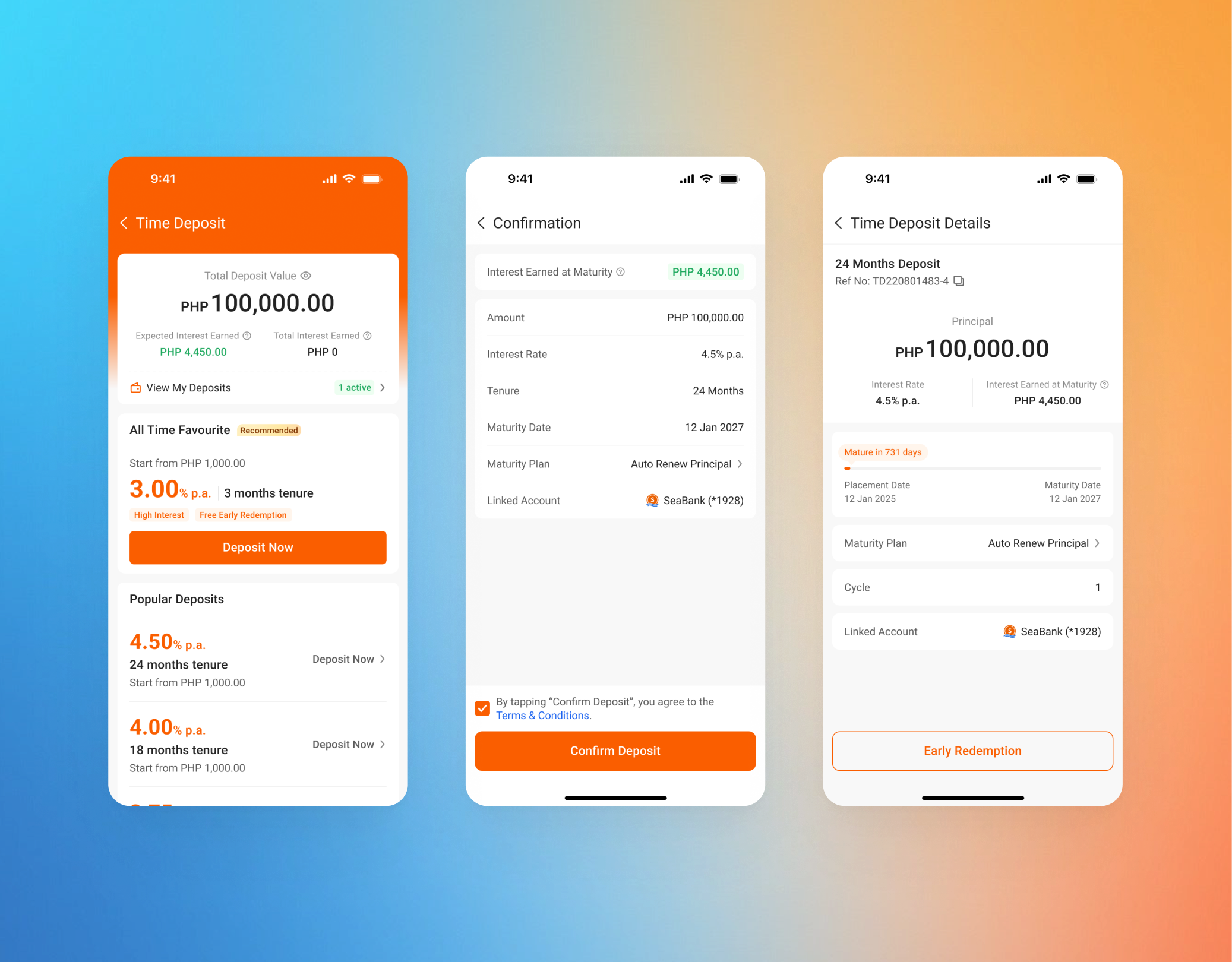
The final design adds a “Maturity Plan” in placement with a list + bottom sheet pattern. It keeps the flow lightweight, improves clarity, and ensures users confirm Auto Renew intentionally, with an easy way to change it before maturity.
Results & Impacts
Here's what we saw 4 months post-launch (Aug-Dec 2025)
22%
Auto-Rollover Adoption
Showing users understood & voluntarily enabled it in-flow.
27%
Post-Maturity Drop-Off (72H)
The % of matured TD balances not re-invested within 72 hours fell from 44% → 27%, shrinking the leakage window.
+9.7%
Portfolio Retention Volume
Day-14 retained principal improved by 9.7%, driven by fewer idle days before re-deposit.
Key Learnings

Timing shapes trust
Asking for decisions only when users have enough context prevents hesitation and unintended opt-ins.

Adoption isn't the goal
Real success is money staying invested after maturity, not just users turning a feature on.

Defaults must feel reversible
Rollover and maturity details are buried in account pages, with no clear countdown or visibility.

Use plain words
Plain and straightforward copy not only builds trust but also significantly reduces confusion among users.
Future Improvements
Dynamic Rate Messaging
Introduce "Rate Alerts" so users are notified if the auto-renew rate drops significantly compared to their initial term.
Goal-Based Deposit
Let users set a goal with their time deposit to increase motivation and encourage them to keep their money in our platform.
Compounding Growth
Offer a "Principal + Interest" auto-renewal option, maximizing compounding benefits for users and AUM for the bank.